
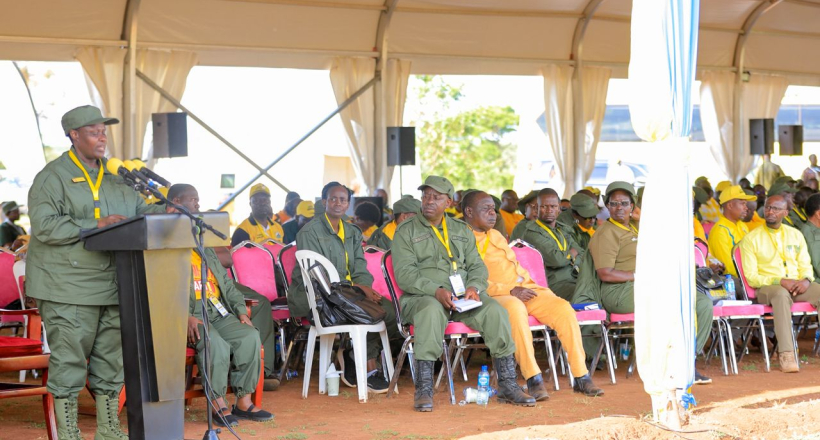
The National Resistance Movement (NRM) leaders’ retreat at the National Leadership Institute (NALI) in Kyankwanzi entered its fifth day on Saturday, with a strong focus on deepening legislators’ understanding of the roles, coordination, and interdependence of the three arms of government.
The sessions brought together senior party leaders, Members of Parliament-elect, and government officials, with discussions centering on strengthening governance, improving service delivery, and aligning leadership with national priorities.
Vice President Maj (Rtd) Jessica Alupo emphasized the importance of harmony among the Executive, Legislature, and Judiciary, emphasizing that while each arm has distinct constitutional mandates, they must work in a complementary and coordinated manner.
She noted that there should be no barriers between the three arms of government, as all are united by a common purpose of serving the people.
She urged legislators to avoid extreme positions and instead embrace cooperation, stressing that national interest must always take precedence over identity-based politics.
“As leaders, we must stand for, stand with, and stand out in support of all arms of government. Our shared objective is to deliver services to our people through unity and collaboration,” she said.
The Vice President also highlighted the importance of science, technology, and innovation in driving Uganda’s transformation, calling on legislators to support government investments in key sectors such as the pathogen economy, the automobile industry, artificial intelligence, and other areas that enhance productivity in agriculture, manufacturing, services, and ICT.
She further emphasized the need for leaders to actively engage with programs under the Ministry of Gender, Labour and Social Development to address challenges affecting women, youth, the elderly, and persons with disabilities.
She encouraged MPs to take initiative in connecting their constituencies to these programs.
Alupo also called for stronger mentorship of young people and greater accountability in the utilization of government resources, noting that while support is being extended, leaders must ensure it translates into meaningful outcomes.
On education, she stressed the need to expand access to higher education to address brain drain and position Uganda as a producer of skilled labor for both domestic and international markets. She urged fast-tracking the establishment of public universities across all regions.
She also pointed to persistent service delivery gaps, particularly in electricity infrastructure, citing cases where some areas have poles without wires or wires without poles. She called for urgent attention to such issues to ensure equitable access to services.
Prime Minister Robinah Nabbanja delivered a detailed presentation on the coordination and management of government business in Parliament, outlining her constitutional role as Leader of Government Business.
She explained that this responsibility involves overseeing the implementation of government policies across ministries, departments, agencies, and local governments, ensuring that agreed priorities are effectively translated into action.
Nabbanja highlighted that while the Rules of Procedure of Parliament provide a formal framework for conducting business, much of the coordination happens through continuous engagement and consensus-building, often referred to as the “corridors of authority.”
She stressed the importance of aligning all government entities to avoid duplication, reduce delays, and improve efficiency in service delivery.
The Prime Minister also emphasized the value of a bottom-up approach to policymaking, where views from communities, local leaders, and civil servants are incorporated into national decision-making processes.
She further explained the legislative process, noting that government business must be approved by Cabinet and properly scheduled on the Order Paper by the Speaker in consultation with the Leader of Government Business before it can be considered in Parliament.
Nabbanja called on Members of Parliament to consistently support government business, use the party caucus effectively, and work collectively to safeguard national achievements and drive Uganda’s transformation agenda.
NRM Secretary General Richard Todwong said the retreat is playing a critical role in equipping legislators with the knowledge and clarity needed to execute their responsibilities effectively.
He noted that the ongoing sessions are designed to align MPs with government programs, strengthen coordination between the party and state institutions, and build a shared understanding of governance principles.
Todwong also highlighted the importance of the evening campfire sessions, describing them as a unique platform for informal engagement, mentorship, and building resilience among legislators.
“The campfire sessions are not just symbolic; they help members interact freely, share experiences, and build the cohesion needed to work together effectively,” he said.
He added that the extended sessions, including those held at night, reflect the commitment of leaders to fully grasp national issues and prepare for the responsibilities ahead.
“This retreat is meant to ensure that our leaders clearly understand how government works and how best they can contribute to national development,” he said.
The Kyankwanzi retreat continues to serve as a key platform for the NRM to shape policy direction, strengthen cohesion among leaders, and prepare legislators for effective participation in governance.