
President Yoweri Kaguta Museveni has said Uganda’s economy is currently growing at about seven percent annually, a pace he described as strong and set to accelerate further with the start of commercial oil production later this year.
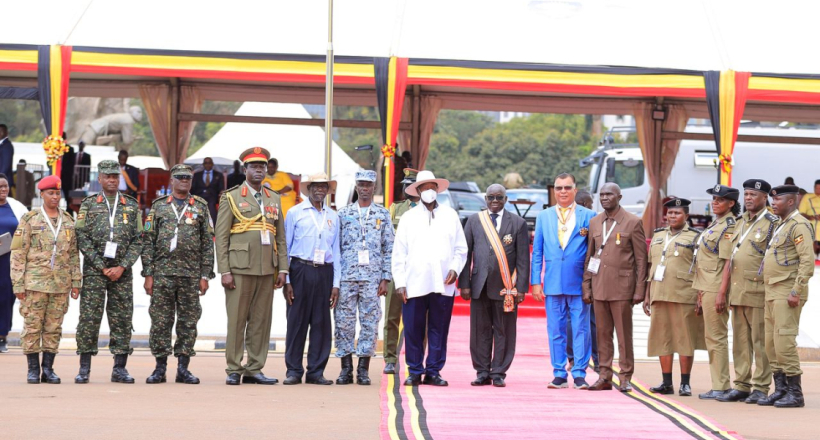
Speaking at the 40th Liberation Day celebrations held at the Kololo National Ceremonial Grounds on January 26, 2026, President Museveni said the steady growth reflected four decades of stability, recovery, and structural transformation under the National Resistance Movement (NRM).
“The economy is moving very fast, growing at seven percent now, and with the oil, we are going to go into double digits. This year, your oil will start flowing,” President Museveni said, adding that Uganda had successfully safeguarded its petroleum resources from external control.
The celebrations, held under the theme “Tribute to the Patriots who ushered in a fundamental change,” came just days after President Museveni was declared winner of the recently concluded presidential election, securing 71 percent of the vote.
In his address, the President thanked God and Ugandans for peacefully completing the electoral process.
“I thank God for having seen us through this big exercise of elections. Secondly, I salute all Ugandans for participating in the elections. I thank all the NRM members for supporting the NRM and its flag bearers,” he said.
While describing the election outcome as a major political victory, President Museveni expressed concern over what he termed as low voter turnout among NRM supporters, noting that internal party records indicated that many eligible supporters did not cast their ballots.
“I got eight million votes, but ten million of my supporters of NRM did not turn up to vote,” he said, attributing the low turnout partly to intimidation by opposition supporters and indiscipline among some NRM leaders.
Turning back to the economy, President Museveni said Uganda’s growth had been accompanied by a steady expansion of participation in the money economy. He revealed that about 70 percent of Ugandans are now engaged in the money economy, compared to just nine percent at independence in 1962.
“This transformation did not come by accident,” he said, tracing progress through successive government interventions aimed at moving households from subsistence production to commercial activity.
He explained that by 2013, only 32 percent of households were participating in the money economy, prompting the introduction of Operation Wealth Creation (OWC), through which agricultural inputs were distributed nationwide with support from the Uganda People’s Defence Forces (UPDF).
By 2019, he said, the proportion had risen to 61 percent, but challenges of elite capture led to the introduction of the Parish Development Model (PDM), which channels resources directly to communities.
“Now we are at 70 percent in the money economy, and about 30 percent are still outside,” President Museveni said. “We don’t want a country of 70 percent rich people while 30 percent are poor.”
He warned against the misuse of PDM funds, citing cases where parish officials and committees had diverted resources for personal benefit, contrary to programme guidelines. He said government would tighten rules, increase funding—especially in urban parishes—and enforce accountability.
Beyond PDM, President Museveni said government would continue supporting boda boda riders, ghetto youth, unemployed graduates, cultural and religious leaders, and grassroots political structures, with wealth creation remaining the top priority.
Once household incomes improve, he added, government would intensify investment in education, health, and infrastructure, particularly road maintenance.
On governance, President Museveni said the fight against corruption would extend to the judiciary, praising the new Chief Justice, Dr Flavian Zeija, for taking a firm stance against judicial corruption.
Responding to claims that Uganda had not changed over the last 40 years, President Museveni outlined what he described as five phases of economic recovery and transformation since 1986, culminating in the current transition to a knowledge-based economy.
He highlighted progress in commercial agriculture, manufacturing, services, and ICT, noting that about 65 percent of products in Ugandan supermarkets are now locally made.
The Minister for the Presidency, Hon. Babirye Milly Babalanda, congratulated President Museveni on his re-election, describing the four-decade NRM journey as transformative and reflective of continued public confidence.
During the ceremony, 33 distinguished Ugandans were awarded national medals for their contribution to the liberation struggle and national development.
January 26 marks the day in 1986 when National Resistance Army fighters captured Kampala, ending years of political instability and ushering in the NRM government led by President Museveni.