

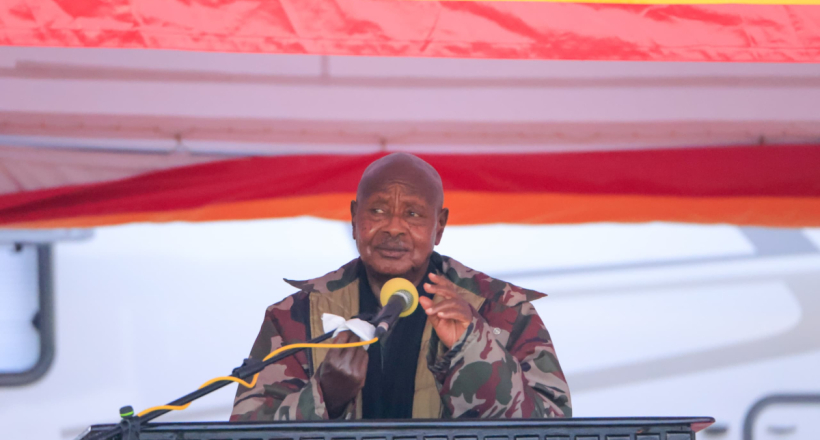
President Yoweri Museveni on Friday outlined eleven key priorities to drive Uganda’s economy to grow tenfold, urging leaders to focus on practical interventions that enhance productivity, expand incomes and transform livelihoods.
Speaking on day four of the ongoing NRM retreat at the National Leadership Institute in Kyankwanzi, Museveni said the country already has the capacity to achieve rapid economic expansion if it fully exploits its existing resources through value addition and efficiency.
“In your heads must be how the economy will grow ten times in a short time. The answer is clear—if we organise ourselves around these key points,” Museveni told legislators.
He placed strong emphasis on value addition, noting that Uganda loses significant income by exporting raw materials.
“We get only about $2.5 per kilo of coffee as raw beans. If we roast, grind and package it, we can earn between $25 and $40 from the same kilo,” he said.
The President also highlighted the need to monetise the economy by bringing all households into commercial production. He cited rural areas where many families still produce only for subsistence, stressing that government programmes such as the Parish Development Model (PDM) are aimed at integrating them into the money economy.
On long-term transformation, Museveni underscored the importance of building a knowledge-based economy driven by science and technology.
“We must go beyond coffee and cotton and start producing vaccines, automobiles and computers,” he said.
Infrastructure development was identified as another critical pillar, particularly investment in railway transport to lower the cost of doing business.
“Rail transport is cheaper than road. If we reduce transport costs, businesses will make more profit and expand,” he noted.
Museveni also pointed to the need for reliable and affordable electricity to support industrial growth, saying Uganda has already invested in major power projects but must ensure stability in supply.
On financing, he stressed reducing the cost of credit, especially for manufacturers, through government-backed institutions.
“We shall provide cheaper money for those involved in production—not for consumption like nightclubs—but for manufacturing and wealth creation,” he said.
The President further called for improved revenue collection through the use of ICT systems while tackling corruption, which he described as a major impediment to economic growth.
A key area of focus was cost-effective delivery of social services, particularly preventive healthcare and education.
“A lot of sickness is avoidable. If people immunise, eat well, exercise and sleep under mosquito nets, we can prevent up to 80 percent of illnesses,” Museveni said, adding that government must also ensure access to schools at parish and sub-county levels.
He also highlighted the importance of the creative and services sector, including music, sports and entertainment, noting that these industries are increasingly contributing to the economy, especially among young people.
Urban development, particularly in the Greater Kampala Metropolitan Area, was also singled out. Museveni said addressing traffic congestion in Kampala would significantly improve economic efficiency.
“Traffic jams cost a lot of money, but we shall solve that problem,” he assured.
He concluded by stressing the need to decisively fight corruption, proposing it as a critical additional priority to support all other interventions.
“Corruption must be fought. It is one of the key issues affecting our progress,” he said.
Museveni urged leaders to concentrate on the eleven priorities, saying focusing on core areas would accelerate Uganda’s journey towards sustainable economic transformation.