President Yoweri Kaguta Museveni has outlined Uganda’s economic recovery journey since 1986, highlighting the country’s growth from an economy valued at approximately USD 3.9 billion to USD 69.3 billion, while calling for accelerated industrialisation, value addition and household wealth creation.
Speaking during Uganda’s 64th Independence Day celebrations on October 9, 2026, held virtually from State House, Entebbe, President Museveni said the country’s next phase of transformation would depend on expanding production, increasing household incomes and retaining more value from locally produced goods.
The celebrations were held under the theme: “Embracing Our Sovereignty with Hope and Visionary Leadership.”
Uganda attained independence from Britain on October 9, 1962. Reflecting on the country’s journey, President Museveni said 24 of the 64 years had been lost to political instability, conflict and economic decline before the National Resistance Movement (NRM) government took power in 1986.
“First of all, I congratulate all Ugandans on this occasion of 64 years of Independence. Those 64 years, some of the years were wasted between 1962 and 1986. We had 24 years of conflict and decline and fighting,” he said.
President Museveni said the economy had contracted to approximately USD 3.9 billion by 1986, requiring the government to pursue a phased recovery strategy that has since expanded the country’s productive base.
He projected that Uganda’s economy would reach nearly USD 74 billion by June 2027, driven by industrialisation, value addition, the anticipated contribution of oil production and the growth of new sectors.
From economic collapse to recovery:
The President said colonial economic policy had left Uganda dependent on a narrow range of agricultural and commodity exports, with much of the population excluded from the formal money economy.
“The British left a small cash economy of 3Ts and 3Cs, including copper, cotton and coffee, tobacco, tourism and tea,” he said.
According to President Museveni, the economy reached only a small proportion of the population, leaving many households largely dependent on subsistence production.
He added that the regime of former president Idi Amin further weakened the economy, with several key sectors suffering severe decline.
“When Idi Amin came, he destroyed this small money economy. By the time I came in, out of the 3Cs and 3Ts, copper had collapsed, cotton was okay, coffee was struggling, tourism had collapsed, tea had collapsed. It was only tobacco that was struggling,” he said.
President Museveni said the NRM government subsequently pursued five phases of economic transformation: minimum recovery, expansion, diversification, value addition and the development of a knowledge-based economy.
The first phase involved restoring production in sectors that had collapsed, while subsequent phases focused on expanding existing activities and introducing new sources of income.
He cited the recovery of tea production, which he said had increased from three million kilogrammes to 60 million kilogrammes, alongside the revival of coffee, cotton and tourism.
Coffee production, he added, had risen from approximately three million bags to nine million bags.
President Museveni said economic transformation also required changing attitudes towards agricultural products that colonial economic structures had largely treated as subsistence goods rather than commercial opportunities.
He questioned why milk, fruits, maize, beans, bananas, millet and fish had not been fully developed as income-generating commodities.
He recalled seeing imported milk products in shops in Ntungamo in the early 1950s while local milk producers struggled to access commercial markets.
“I was a milk man, but my milk wasn't in the shops under the colonial system,” he said.
The President said the government had encouraged farmers to treat a wider range of agricultural products as commercial enterprises, creating opportunities for household income, employment and domestic industrial development.
He cited fruit growing and other agricultural activities as examples of products that could contribute more significantly to the economy when farmers were organised, supported and connected to markets.
The diversification strategy, he said, was intended to reduce dependence on a narrow range of traditional exports and broaden the country’s productive capacity.
Value addition: Uganda’s next economic frontier
The President identified value addition as one of the most important priorities in Uganda’s pursuit of economic independence, arguing that exporting raw materials deprives producers of substantial earnings.
He said Uganda had made progress in processing cotton, milk, bananas, coffee and fruits but needed to expand these activities to capture more value locally.
“When you add value, you get much more money than when you sell raw materials,” he said.
Using coffee as an example, President Museveni explained that a kilogramme of raw coffee could fetch approximately USD 2, while processed coffee products could command significantly higher prices, depending on the product and market.
He argued that the countries and companies involved in roasting, grinding, packaging and marketing often capture a substantial share of the value generated along global commodity supply chains.
“This is the battle we are engaged in, value addition,” he said.
President Museveni urged Ugandans to see industrial processing not merely as an economic activity but as a strategic priority for retaining wealth, creating jobs and strengthening the country’s ability to finance its own development.
The push for value addition, he said, would help Uganda transition from being primarily a supplier of raw materials to becoming a producer of finished goods for domestic and international markets.
The President identified the knowledge economy as the fifth phase of Uganda’s economic transformation, emphasising the growing role of science, technology and innovation in wealth creation.
He cited electric vehicle manufacturing and pharmaceuticals, alongside computers and other knowledge-intensive products, as areas in which Uganda was seeking to expand its capabilities.
“There are products which are products of knowledge, science, and that's where we have started moving. Uganda is making electric vehicles. We are now using knowledge to produce wealth,” he said.
President Museveni said the country’s long-term economic prospects would depend on its ability to build domestic technological capacity, develop skilled human resources and support industries capable of producing higher-value goods.
He maintained that these efforts, combined with oil production and continued industrial expansion, would help grow the economy from its 1986 level of USD 3.9 billion to nearly USD 74 billion by June 2027.
Transport infrastructure and the cost of doing business:
President Museveni identified transport infrastructure as another major challenge, citing traffic congestion, the movement of heavy cargo by road and the transportation of petroleum products by tankers as constraints on economic efficiency.
“One of the gaps we shall have to deal with is the transport system, now it's akatogo, the traffic jam,” he said.
He explained that increased vehicle ownership and the concentration of cargo, petroleum products and passenger transport on roads had created pressure on the transport network.
The President said the government was working with Kenya on petroleum pipeline infrastructure to reduce the movement of fuel tankers by road, while plans to expand railway transport would ease pressure on highways.
He cited the rehabilitation of the existing metre-gauge railway and plans for the Standard Gauge Railway (SGR), alongside improved water transport, as part of efforts to develop an integrated transport system.
President Museveni also highlighted plans for railway connections to western Uganda and the mineral-rich Karamoja sub-region, which he said had significant deposits of marble, limestone and gold.
He estimated that inefficiencies associated with the current transport system cost Uganda approximately USD 1 billion annually.
Improved transport infrastructure, he said, would reduce logistics costs, facilitate the movement of goods and make locally produced commodities more competitive.
Wealth creation and household incomes:
The President also emphasised the need to bring more households into the money economy through commercial agriculture, enterprise development and government wealth-creation programmes.
He said Operation Wealth Creation had increased the proportion of Ugandans participating in the money economy from 32 per cent to 61 per cent, while the Parish Development Model (PDM) had raised the figure further to 67 per cent.
President Museveni challenged political, religious and cultural leaders to assess the socio-economic conditions of households in their respective parishes and identify those still excluded from commercial economic activity.
He cited Kisozi, where he said he had observed widespread poverty when he visited in 1990, but now approximately 90 per cent of households were participating in the money economy.
The President also recounted the experience of a woman identified as Deziranta Tumusiime from Rubirizi, who, he said, had not owned productive assets until she benefited from the Parish Development Model.
He argued that poverty reduction required more than national economic growth figures, stressing the importance of ensuring that individual households acquired productive assets and established sustainable sources of income.
“For me, who is interested in coffee, we shall have additional programmes like we are growing seedlings in Kisozi,” he said.
President Museveni said the government would continue supporting households with coffee and fruit seedlings, dairy production, pasture development, piggery, poultry and fish farming.
He said these interventions were intended to bring the remaining 33 per cent of the population outside the money economy into productive commercial activity.
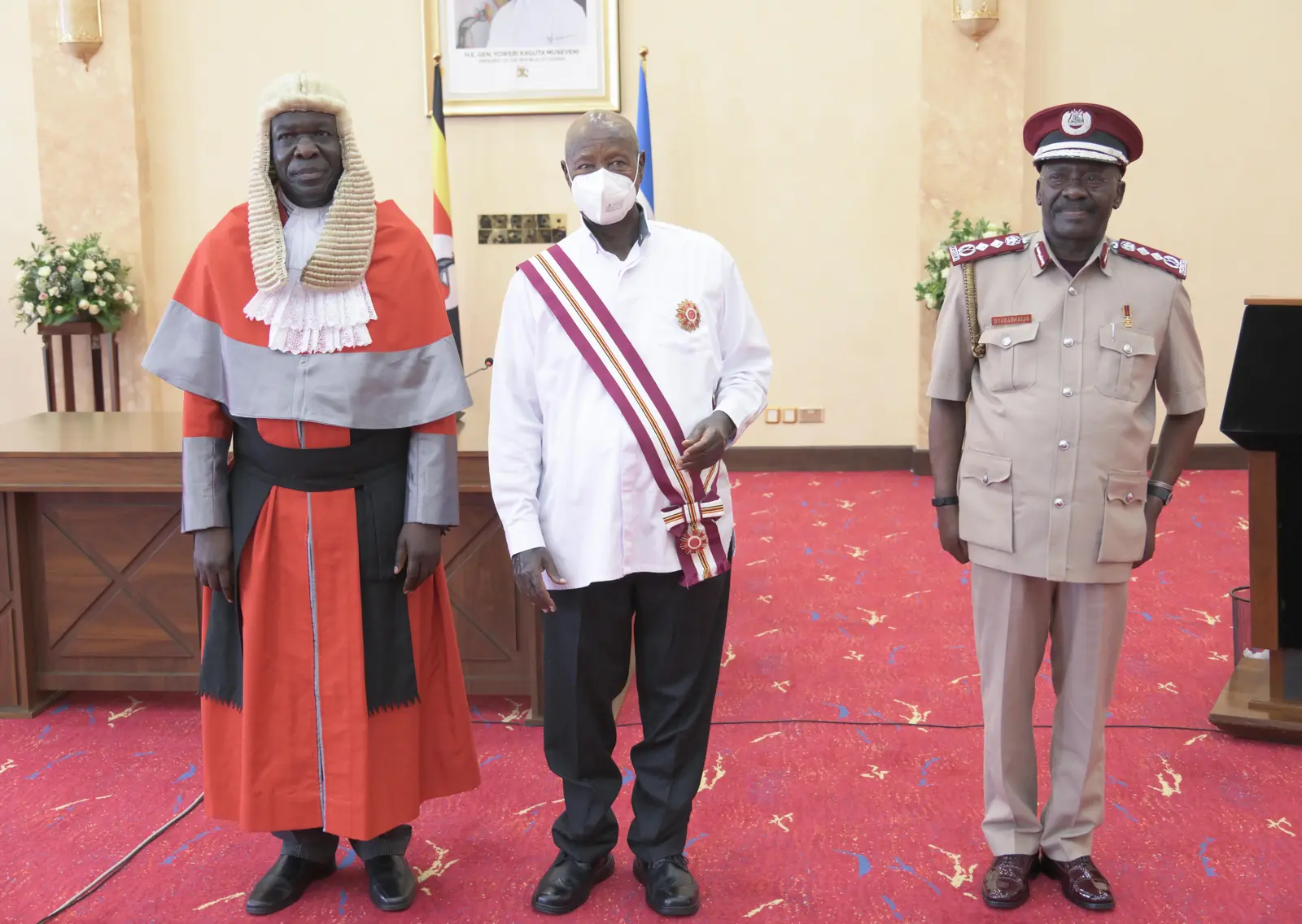
During the celebrations, President Museveni was decorated with the Order of the Commander-in-Chief (Uganda Prisons Service Medal), in recognition of his leadership and championing peace and security.
The award was also in line with his contribution to the development of the Uganda Prisons Service, recognising his direction for the service to engage in large-scale production, including cotton growing, to support food security, import substitution and self-reliance.
It further recognised government efforts to procure locally made furniture from the Prisons Service rather than relying on imports, as well as improvements in staff accommodation.
The medal was conferred under Section 3(2), Second Schedule, Part I of the National Honours and Awards Act, 2001, as amended.
It was presented by Deputy Chief Justice, Hon. Justice Moses Kawumi Kazibwe on behalf of the Presidential Awards Committee, chaired by Hajjat Zamina Malole.
Vice President hails progress in stability and women’s empowerment:
Vice President, H.E Jessica Alupo congratulated Ugandans on the 64th anniversary of independence, praising President Museveni’s leadership and the country’s progress in stability, peace, unity and development.
“I congratulate you and all the people of Uganda upon reaching 64 years of Independence,” she said.
H.E Alupo said Uganda had followed a path of inclusivity and development, with particular emphasis on women’s empowerment.
She pledged that women leaders would continue supporting government efforts to advance the country’s development agenda.
The Vice President also commended the government’s 10-fold growth strategy, which identifies priority sectors for expanding economic activity and improving household incomes.
Minister for the Presidency, Hon. Babirye Milly Babalanda said the Independence Day theme invited Ugandans to reflect on the country’s history, honour those who fought for freedom and recognise the responsibilities that come with sovereignty.
She paid tribute to historical figures, including Omukama Kabalega of Bunyoro and Kabaka Mwanga, alongside other known and unknown patriots who contributed to the struggle for political independence.
“Uganda's Independence wasn't achieved on a silver plate,” Hon. Babalanda said.
She argued that political independence was only the first stage of liberation, adding that economic and strategic independence remained central to Uganda’s development ambitions.
“President Museveni has consistently emphasised that economic Independence is the way to go,” she said, noting that the country was seeking to move beyond exporting raw materials towards producing value-added goods.
19 others decorated:
At least 19 other people, including six women, were decorated during the celebrations in recognition of their respective contributions to the country.
Among the awardees were Commissioner General of Prisons, Can. Dr. Johnson Byabashaija, Kampala Parents' School founder Edward Kasole Bwerere Lwanga, Deputy Commander of the Air Force Maj. Gen. David Isimbwa and Chief of Staff of the Land Forces Maj. Gen. Francis Bagonza.
Attorney General Hon. Dr. Sam Mayanja also used the occasion to launch his book, “The Odyssey in the Uganda Land Cobwebs”, which examines land matters in Uganda.
The event was physically attended by a select group of distinguished guests, while other Ugandans followed the proceedings on Uganda Broadcasting Corporation (UBC) and other media houses around the country.